Predictive Processing Flash is a trauma reprocessing method developed by Thomas Zimmerman, LPCC, building on the Flash Technique developed by Philip Manfield, PhD. It works without asking you to describe what happened. I am trained in it and offer it online in New York, in English and Mandarin.
Living between languages and expectations trains you to anticipate. You read a room before you enter it, and your body prepares for outcomes that have not arrived yet. Anticipation is a skill, and it is also why some memories hold their charge long after your life has changed around them. Your brain forecasts what will happen if you go near a difficult memory: the flooding, the shame, the rest of the day lost. That forecast was earned, and it keeps running whether or not it still fits your life. Predictive Processing Flash works by giving it something different to compare itself against.
This "Turn & Learn" guide frames Predictive Processing Flash as a supplement for updating what your nervous system predicts, formulated for people carrying memories they have never put into words, in any language.
DIRECTIONS FOR USE (When to use)
This formulation is often indicated when:
- You know exactly which memory sits under your reactions, and you have never said it out loud to anyone.
- Talking about what happened floods you, and the rest of the day goes to recovering from the session.
- What you carry involves family, and naming details out loud feels like a betrayal of people you also love.
- There is not one memory but many, stretching back far enough that working through them one story at a time seems impossible.
- You notice yourself steering around a subject in every conversation, in both languages, without ever deciding to.
- Your body braces for something before your thoughts have caught up to what it is bracing for.
USER'S MANUAL
Respect the Forecast: Your brain's predictions about a memory were accurate when they formed, and they do not change through reasoning or willpower. What updates them is an experience that comes back different from what was predicted. My work is to set up those moments and keep them inside what you can hold. I do not need to know what happened, so you can call a memory "the hospital one," or give it no name at all, and the work still moves.
WARNINGS: The research is early. Published studies on this family of methods are small and preliminary, and research on Predictive Processing Flash specifically is still being organized. A session that feels manageable does not mean nothing is happening, and material can surface in the days afterward. Relief that arrives without costing you much can feel suspicious, particularly if you were raised to believe healing should be difficult in order to count. Self-administered versions exist and are meant for use after you have processed successfully with a practitioner, and that order matters most for people carrying complex trauma or dissociation.
Drug Interactions (Synergy): Predictive Processing Flash often combines well with other supplements. It may be paired with EMDR when a memory needs fuller processing, with ACT when the question is how to live by your values while difficult material is still active, or with parts work when one part wants a memory addressed and another has been guarding it.
Dosage Instructions: Between sessions, notice forecasts rather than memories. Before something you are dreading, ask what you are predicting will happen; afterward, ask what actually happened. Once a memory has cleared in session, self-administration becomes available to you as a between-session tool, and I will show you how.
Storage: Store within a therapeutic relationship grounded in trust, consent, and attunement. Keep in a place where your nervous system sets the pace and nothing opens faster than you agree to.
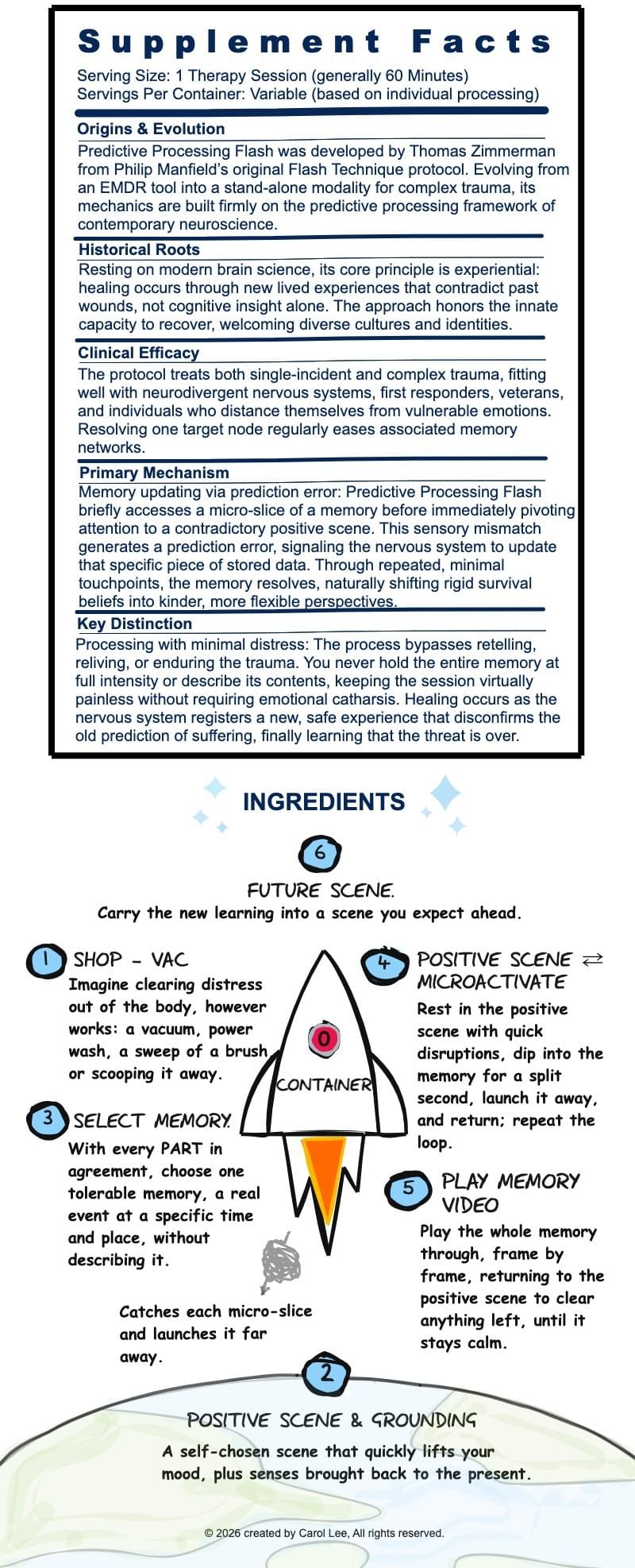
This guide is for educational and reflective purposes. The description here is my own, written for clients, and is not a training document or a protocol. In practice, every formulation is customized to your needs, readiness, consent, and the therapeutic relationship.