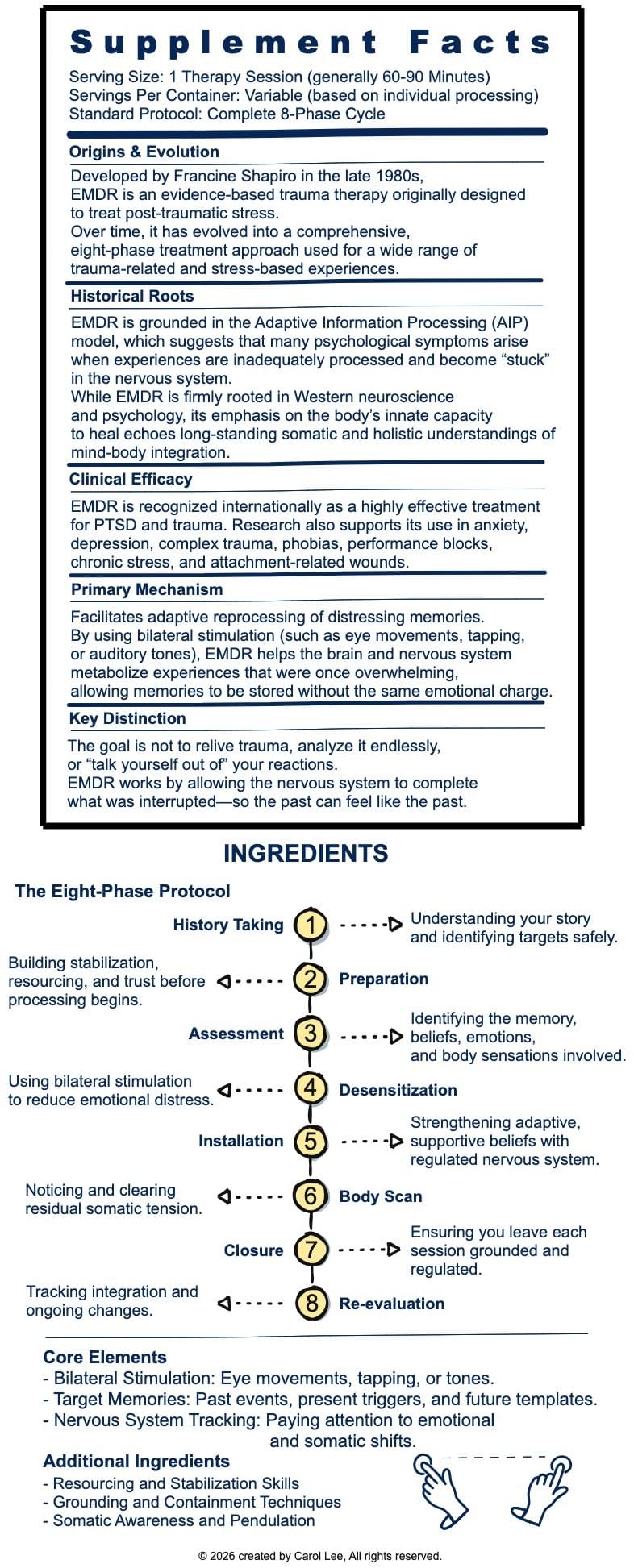
Navigating life within Asian communities often involves carrying unspoken ancestral weights that the body remembers, even when the mind tries to move on. This "Turn & Learn" guide treats EMDR as a specialized cognitive nutrient designed to help your nervous system metabolize these lingering echoes. If you find your internal "alarm system" triggering despite logical safety, or your reactions feeling disproportionate to the present moment, this formulation offers a pathway to somatic quiet.
Below is the technical breakdown for integrating this supplement into your wellness practice.
DIRECTIONS FOR USE (When to use)
- Use when past experiences keep intruding into the present, even when you “know logically” you’re safe.
- Use when emotional reactions feel bigger, faster, or more intense than the situation seems to warrant.
- Use when you feel stuck in patterns that don’t match who you are now.
- Use when talking about something hasn’t helped, or has helped only up to a point.
- Use when your body remembers what your mind is trying to forget.
USER’S MANUAL
The Brain’s Natural Healing System:
EMDR is not something done to you—it activates something already within you. My role is to help create the conditions where your nervous system can do what it is designed to do: process, integrate, and restore balance. We move at a pace that respects safety, consent, and readiness.
WARNINGS:
This supplement does not erase memory; it changes how memory lives in the body.
Processing may temporarily increase emotional or somatic awareness between sessions.
Stabilization and preparation are required before full dosing begins.
Active collaboration and honest feedback are essential.
Drug Interactions (Synergy):
EMDR often works well in combination with other supplements. It may be paired with ACT to support values-based living after trauma processing, or with parts work when different internal experiences hold conflicting needs or fears.
Dosage Instructions:
Do not rush to the highest dose. Effective treatment is titrated carefully, with pacing guided by your nervous system—not a timeline.
Storage:
Store in a therapeutic relationship built on trust, consent, and attunement. Keep accessible during moments when the past refuses to stay in the past.
These supplement descriptions are provided for educational and reflective purposes. They describe how different therapeutic approaches may be used and integrated within my clinical work, rather than offering a standardized or one-size-fits-all treatment. All formulations are customized based on individual needs, consent, readiness, and the therapeutic relationship.